How to Play Golf for Beginners: A Complete Guide to Getting Started
*We may earn a commission for purchases made using our links. Please see our disclosure to learn more.
Golf can look complicated when you are new to the game. There are different clubs, unfamiliar terms, written and unwritten rules, and dozens of swing tips competing for your attention. But the basic idea is simple: use a golf club to move the ball from the teeing area into the hole in as few strokes as possible.
You do not need a perfect swing or an expensive bag full of equipment to start playing. In fact, beginners usually improve faster when they focus on a few fundamentals: making consistent contact, learning basic club selection, developing a reliable short game, understanding simple course etiquette, and gradually becoming comfortable playing on a real course.
This guide explains how to play golf for beginners step by step, from learning the objective and choosing your first equipment to making a golf swing, keeping score, practicing effectively, and completing your first round.
“Play the course as you find it and play your ball as it lies.”
— Source: USGA, Rule 1 of the Rules of Golf.
Key Takeaways
- The objective of golf is to complete each hole using as few strokes as possible.
- Beginners should prioritize consistent contact and direction before trying to maximize distance.
- Learn the grip, stance, posture, alignment, and basic swing before worrying about advanced techniques.
- You do not need every type of club immediately; a beginner-friendly set covering the major shot types is enough to start.
- Spend significant practice time on putting and shots around the green because these strokes make up a large part of a typical round.
- Learn basic rules and etiquette before your first round so you can play confidently without slowing down the group behind you.
- Start on a driving range, practice facility, par-3 course, or nine-hole course before tackling a difficult 18-hole layout.
4 Useful Golf Products for Beginners
Beginners generally benefit more from equipment that emphasizes forgiveness, simplicity, and value than from tour-level gear.
1. Callaway Strata Complete Golf Set


The Callaway Golf Strata Complete Golf Set is designed for beginners and recreational golfers who want a ready-to-play setup with an emphasis on distance, forgiveness, and control. The 12-piece set includes a lightweight 460cc driver, fairway wood, hybrid, irons, putter, stand bag, and headcovers, giving golfers the essential clubs needed from tee to green. Its forgiving construction and easy-to-hit club designs make it a practical choice for players developing their swing and building confidence on the course.
- Beginner-Friendly: Forgiving clubs help make consistent contact easier.
- Complete Setup: Includes essential clubs, bag, and headcovers.
- Good Versatility: Covers tee shots, fairway play, approaches, and putting.
- Limited Club Selection: The 12-piece set may feel basic as skills improve.
- Flex Options: Regular flex may not suit every golfer's swing speed.
- Upgrade Potential: More experienced players may eventually want specialized clubs.
The Callaway Strata Complete Golf Set is a practical choice for someone starting without existing equipment.
The men’s 12-piece configuration includes a driver, fairway wood, hybrid, irons, pitching wedge, putter, stand bag, and headcovers. The combination gives a new golfer the essential types of clubs needed to learn shots from the tee, fairway, rough, around the green, and on the green.
A complete package also removes the confusion of buying individual clubs before you know which specifications or club styles suit your game.
Best for: Beginners who want a convenient first set rather than building a bag club by club.
2. TaylorMade Distance+ Golf Balls


The TaylorMade Golf Distance+ Golf Balls are designed for golfers who want more distance, reliable speed, and a softer feel at an accessible price point. Their two-layer construction combines a REACT Speed Core with an ionomer cover, while the Extended Flight Dimple Pattern helps maintain flight and carry through the air. A built-in Plus Alignment Aid also makes it easier to line up tee shots and putts, making these balls a practical option for beginners and recreational golfers.
- Long Distance: REACT Speed Core promotes fast ball speed and longer shots.
- Helpful Alignment: Built-in alignment aid assists with aiming on drives and putts.
- Beginner-Friendly: Softer feel and straightforward performance suit developing golfers.
- Limited Greenside Control: Two-piece construction may offer less finesse than premium balls.
- Higher Spin: Mid-to-high spin may not suit golfers trying to reduce excess spin.
- Distance Focused: Players prioritizing advanced short-game performance may prefer another model.
New golfers often lose golf balls, so starting with expensive tour-level balls usually makes little sense.
TaylorMade Distance+ Golf Balls are designed around distance and value, making them suitable for recreational players who want a straightforward ball without paying premium prices.
For beginners, the main advantage is practical: you can learn and play without worrying excessively about every ball that disappears into rough, trees, or a penalty area.
Best for: Beginners who want an affordable ball focused primarily on distance and everyday play.
3. FootJoy WeatherSof Golf Glove


The FootJoy Men's WeatherSof 2-Pack Golf Glove is designed to provide golfers with a secure grip, comfortable fit, and dependable flexibility throughout a round. It uses FiberSof material for a soft feel and consistent fit, while FiberSof MicroTac reinforces key stress areas to improve grip performance. Breathable PowerNet mesh across the back of the hand adds flexibility and ventilation, and the adjustable ComforTab closure helps create a snug, reliable fit.
- Secure Grip: MicroTac material improves grip in high-stress areas.
- Breathable Design: PowerNet mesh helps keep the hand comfortable during play.
- Good Value: Two gloves provide a convenient backup for regular golfers.
- Synthetic Feel: Golfers who prefer premium leather may find it less traditional.
- Fit Dependent: Choosing the correct size is important for consistent grip and comfort.
- White Color: The light finish can show dirt and wear more quickly.
A glove can improve comfort and help maintain a secure grip, especially during longer practice sessions.
The FootJoy WeatherSof Golf Glove uses FiberSof material, additional grip material in high-stress areas, breathable mesh, and an adjustable closure designed to provide a consistent fit and grip.
Most right-handed golfers wear a glove on the left hand, while most left-handed golfers wear one on the right.
Best for: Beginners who want better grip security and reduced friction during practice.
4. Pride Professional Tee System Golf Tees


The Pride Professional Tee System ProLength-Plus 3 ¼" Golf Tees are designed for golfers who want a consistent tee height, especially when using modern drivers with larger clubheads. At 3 ¼ inches long, they provide enough height to position the ball comfortably for driver shots, while the large pack size makes them practical for regular practice and course play. With approximately 135 tees per pack and two packs included, they offer a convenient supply for beginners and frequent golfers.
- Consistent Height: 3 ¼-inch length works well for driver tee shots.
- Large Quantity: Two packs provide plenty of tees for practice and rounds.
- Beginner-Friendly: Simple design makes setup easy and repeatable.
- Driver Focused: Longer size may be unnecessary for irons or some fairway woods.
- Basic Design: Lacks specialized features found in some premium tees.
- Can Break: Traditional tees may snap after repeated or powerful impacts.
Golf tees are simple but essential for tee shots.
Pride Professional Tee System Golf Tees are available in different lengths, allowing players to find a consistent tee height for drivers, woods, hybrids, and irons.
Using a repeatable tee height is helpful for beginners because it removes one unnecessary variable while learning the golf swing.
Best for: Everyday practice and maintaining consistent setup on tee shots.
What Is the Goal of Golf?
A golf course is divided into holes, usually nine or 18. Every hole begins from a designated teeing area and finishes when your ball enters the cup on the putting green.
Each time you deliberately strike the ball counts as a stroke.
Your goal is to complete the round using the fewest total strokes.
Every hole also has a par, which represents the number of strokes a skilled golfer is generally expected to need to complete it. Most holes are classified as:
- Par 3: usually a shorter hole
- Par 4: usually a medium-length hole
- Par 5: usually a longer hole
If a par-4 hole takes you four strokes, you made par. Finishing in three is a birdie, while finishing in five is a bogey.
Do not worry about shooting par when you are starting. For a beginner, successfully getting the ball around the course, keeping the game moving, and enjoying the experience are much more useful goals.
What Golf Equipment Do Beginners Need?
Golf has plenty of specialized equipment, but beginners can start with a relatively simple setup.
Under the Rules of Golf, a player may carry no more than 14 clubs during a round, but there is no requirement to carry all 14.
A practical beginner bag might contain:
- Driver
- Fairway wood
- Hybrid
- Several irons
- Pitching wedge
- Sand wedge
- Putter
Hybrids are particularly useful for new players because many golfers find them easier to launch than traditional long irons.
You will also need golf balls, tees, a golf bag, comfortable shoes, and preferably a glove.
Learn the Basic Golf Grip
Your hands provide the connection between your body and the club, so learning a neutral grip should come before trying to swing as hard as possible.
For a right-handed golfer:
- Place the grip diagonally across the fingers of your left hand.
- Close your left hand around the club.
- Position the thumb slightly to the right of the center of the grip.
- Place your right hand below the left.
- Let both hands work together rather than squeezing independently.
The three most common styles are the overlap grip, interlocking grip, and ten-finger grip.
Many beginners find the ten-finger grip comfortable, while the overlap and interlock are widely used by experienced players.
Whichever style you choose, avoid gripping the club as tightly as possible. Excessive tension can restrict your wrists and make it harder to swing smoothly.
Think of holding the club securely enough that it will not slip, but softly enough that your arms and wrists can move naturally.
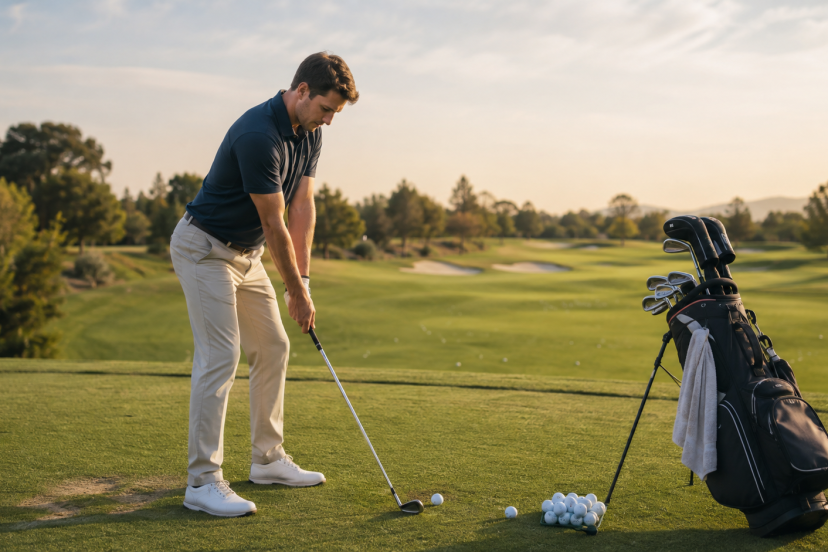
Set Up With the Correct Stance and Posture
Before worrying about the swing itself, establish a repeatable setup.
Start with your feet approximately shoulder-width apart for a normal iron shot.
Then:
- Bend slightly from your hips.
- Allow your knees to flex naturally.
- Keep your back relatively straight rather than rounded.
- Let your arms hang comfortably.
- Distribute your weight around the middle of your feet.
- Aim your feet, hips, and shoulders roughly parallel to your target line.
Your posture should feel athletic and balanced.
Ball position changes depending on the club. With shorter irons, the ball is generally closer to the middle of the stance. As the club gets longer, ball position gradually moves forward.
For a driver, the ball is usually played near the inside of the lead heel.
How to Make a Basic Golf Swing
A golf swing contains many moving parts, but beginners should avoid turning it into a complicated checklist.
Think of the motion in four stages.
1. Address
Set your grip, posture, alignment, and ball position.
Before starting the swing, make sure you feel balanced. Constantly adjusting once you begin moving usually makes consistent contact more difficult.
2. Backswing
Move the club away from the ball while allowing your shoulders and upper body to turn.
Your arms, shoulders, and torso should work together rather than immediately lifting the club with your hands.
As you reach the top of the backswing, maintain your balance. A shorter controlled backswing is usually better for a beginner than an excessively long one.
3. Downswing
Start moving back toward the ball smoothly.
The objective is not to attack the ball with your arms. Allow your body rotation, arms, and club to work together.
Concentrate on making solid contact rather than trying to generate maximum clubhead speed.
4. Follow-Through
Continue rotating after impact rather than stopping the club immediately after hitting the ball.
For a full swing, you should eventually finish with most of your weight on your lead side, your chest facing toward the target, and your body balanced.
A balanced finish is often a good indication that you swung within your capabilities.
How to Hit Different Golf Clubs
Not every golf club should be used the same way.
Driver
The driver is mainly designed for long tee shots.
Because it has a long shaft and relatively low loft, it can also be one of the hardest clubs for beginners to control.
Tee the ball high enough that part of it sits above the top edge of the driver when the club rests behind it. Make a smooth swing and prioritize hitting the center of the clubface.
Do not assume you need driver on every hole. If you can hit a hybrid or fairway wood much straighter, using the shorter club may produce a better score.
Irons
Irons are commonly used for approach shots and shots from the fairway or rough.
With most iron shots, the goal is to strike the ball first and then allow the club to contact the turf.
Trying to scoop the ball into the air is a common beginner mistake. Golf irons already have loft built into the clubface.
Let the club do the work.
Wedges
Wedges are used for shorter approach shots, chips, pitches, bunker shots, and other shots around the green.
Beginners should become comfortable making smaller swings with wedges rather than using only full swings.
Learning how far the ball travels with quarter, half, and three-quarter swings can dramatically improve distance control.
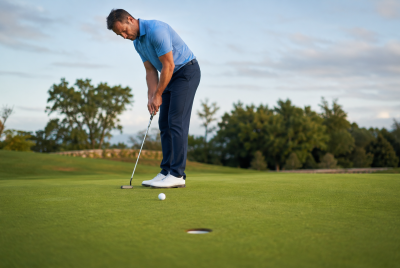
Putter
The putter is used on the putting green and occasionally from closely mown areas surrounding it.
Putting requires less body rotation than a full swing.
Keep your lower body relatively stable, make a smooth back-and-through motion, and concentrate primarily on two things:
direction and distance.
For long putts, getting the ball close to the hole is more important than trying to make everything.
Learn Chipping Before Advanced Short-Game Shots
When your ball is close to the green but not yet on it, a chip is often the easiest option.
Use a wedge or short iron, play the ball around the middle or slightly back in your stance, and make a compact motion.
The objective is usually to get the ball onto the green relatively quickly and let it roll toward the hole.
Beginners often make short-game shots unnecessarily difficult by attempting high, delicate shots when a simple chip would work.
Choose the lowest-risk shot that accomplishes the job.
Understand Basic Golf Rules
You do not need to memorize the entire rulebook before playing your first round, but you should understand several common situations.
Play the Ball as It Lies
One of golf’s central principles is that you normally play the course as you find it and the ball as it lies. There are specific exceptions where the Rules allow relief.
Lost Ball or Out of Bounds
If you believe a shot may be lost outside a penalty area or out of bounds, tell the other players you are playing a provisional ball before hitting another shot.
If the original ball is lost or out of bounds, stroke-and-distance relief is normally required. The current Rules allow three minutes to search for a ball.
Some courses use an optional Local Rule that provides another procedure for lost or out-of-bounds balls during certain forms of general play, so check the course rules before your round.
Penalty Areas
Penalty areas are generally identified with red or yellow markings.
You can sometimes play the ball from inside the penalty area without a penalty. If you choose relief outside it, specific relief options are available for one penalty stroke. Red penalty areas provide an additional lateral relief option.
For your first rounds, carrying a current rules app or quick-reference guide can be much easier than trying to memorize every possible situation.
Golf Etiquette Every Beginner Should Know
Knowing how to behave on a golf course matters almost as much as knowing how to hit the ball.
Keep Up With the Group Ahead
You do not need to play quickly, but avoid unnecessary delays.
Prepare while other players are hitting, choose your club before it is your turn when possible, and avoid spending excessive time looking for clearly lost balls.
Stay Safe
Never hit until the group ahead is safely out of range.
If your shot travels toward another person, immediately shout “Fore!” loudly enough for them to hear you.
Be Quiet During Shots
Avoid talking, moving noticeably, or creating distractions while another golfer is preparing to hit.
Take Care of the Course
Replace or repair divots when appropriate, rake bunkers after use, and repair ball marks on putting greens.
Avoid damaging the green with clubs, bags, or careless foot traffic.
Respect the Putting Line
Try not to step directly on another player’s intended line between their ball and the hole.
These small habits make you easier and more enjoyable to play with, regardless of your score.
How Should Beginners Practice Golf?
Hitting driver after driver at the range is fun, but it is not the most efficient way to improve.
Divide your practice across several areas.
A simple 60-minute session could look like:
- 10 minutes: short putts
- 10 minutes: long-distance putting
- 15 minutes: chipping and pitching
- 15 minutes: irons
- 10 minutes: driver or fairway wood
When practicing full swings, change targets regularly instead of mindlessly hitting dozens of balls with the same club.
On a golf course, you rarely hit identical shots consecutively. Practice should eventually reflect that reality.
A Simple Practice Plan for Your First Month
Week 1: Learn Contact
Focus on grip, posture, half swings, putting, and short chips.
Do not worry about distance.
Week 2: Build a Basic Full Swing
Gradually increase the length of your swing with wedges and mid-irons.
Begin learning a hybrid or fairway wood.
Week 3: Introduce the Driver
Practice tee shots while continuing to spend at least half of your practice time on irons and the short game.
Week 4: Play Golf
Try a par-3 course, short course, or nine-hole round.
Your objective should not be a specific score. Learn how to select clubs, manage distances, handle different lies, maintain pace, and transition between different types of shots.
Common Beginner Golf Mistakes
Trying to Hit Every Shot as Hard as Possible
More effort does not automatically produce more distance.
Solid contact with a controlled swing will usually outperform a violent swing that misses the center of the clubface.
Looking Up Too Early
Beginners commonly lift their upper body before impact because they are eager to see where the ball is going.
Focus on completing the strike and allow your head to follow the body’s rotation naturally.
Using Driver Everywhere
The longest club is not always the best club.
If trouble surrounds the fairway, a shorter club that stays in play may give you a much easier next shot.
Ignoring Putting and Chipping
Driving gets attention, but short-game mistakes can quickly add strokes.
Improving from 50 yards and closer is one of the easiest ways for beginners to lower scores.
Comparing Yourself With Experienced Golfers
A golfer who has played for ten years has accumulated thousands of swings and course situations.
Measure progress through better contact, fewer lost balls, improved putting, smarter decisions, and increased confidence rather than comparing scores immediately.
How to Prepare for Your First Round
Choose a beginner-friendly course if possible.
Before your tee time:
- Arrive early.
- Check in at the golf shop.
- Warm up rather than immediately playing.
- Hit a few short shots before longer clubs.
- Roll several putts to learn the green speed.
- Bring enough golf balls and tees.
- Carry water and appropriate weather protection.
- Ask about any local course rules.
Most importantly, do not feel obligated to finish every difficult hole.
During a casual beginner round, if you are struggling badly and holding up play, it can be better to pick up your ball and continue to the next hole.
Your first rounds are about learning how golf works on the course.
Final Thoughts: Start Simple and Build Your Golf Game Gradually
Learning how to play golf is easier when you stop trying to master everything at once.
Begin with a comfortable grip and athletic setup. Develop a controlled swing that produces reasonably consistent contact. Learn a few dependable clubs. Spend plenty of time putting and chipping. Understand the basic rules and etiquette that keep play safe and enjoyable.
Then get onto the course.
Range practice is valuable, but golf ultimately requires adapting to uneven lies, different distances, hazards, wind, slopes, pressure, and changing targets. Those skills develop through actual rounds.
You will hit poor shots. Every golfer does. What matters is learning how to recover, make a smarter decision on the next shot, and keep playing.
Build those habits early and you will have a much stronger foundation for improving your golf game over time.
Frequently Asked Questions
1. What should a beginner learn first in golf?
Start with grip, posture, alignment, putting, chipping, and making consistent contact with shorter clubs. Once those fundamentals feel comfortable, gradually introduce longer irons, hybrids, woods, and the driver. Trying to master the driver before developing basic contact often makes the learning process unnecessarily difficult.
2. How many golf clubs does a beginner really need?
A beginner does not need the maximum 14 clubs. A driver or fairway wood, hybrid, several irons, wedge, and putter can cover most situations. Complete beginner sets are convenient because they typically provide these essential club types without forcing you to select each club individually.
3. Is golf difficult for beginners?
Golf has a steep learning curve because small changes in the swing can affect where the ball travels. However, you do not need an advanced swing to enjoy playing. Learning reliable contact, basic short-game skills, course etiquette, and sensible shot selection can make golf enjoyable relatively quickly.
4. Should beginners take golf lessons?
A few lessons with a qualified instructor can be extremely helpful because an instructor can identify grip, posture, alignment, or swing problems before they become ingrained habits. Even one or two introductory lessons can provide a clearer practice plan than trying to diagnose every problem alone.
5. How often should a beginner practice golf?
One or two focused practice sessions per week can produce meaningful improvement when combined with occasional rounds. Consistency matters more than hitting hundreds of balls in one session. Divide practice between putting, chipping, irons, and tee shots, and give each shot a specific target rather than simply hitting balls without a purpose.