Golf Course Etiquette: Essential Rules and Tips Every Golfer Should Know
*We may earn a commission for purchases made using our links. Please see our disclosure to learn more.
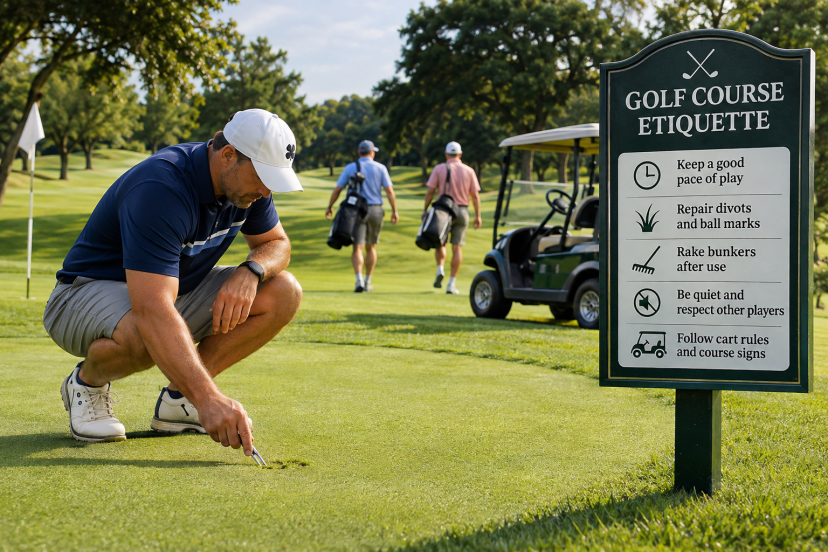
Golf is more enjoyable when everyone understands how to behave on the course. Knowing when to take your shot, where to stand, and how to care for the playing surface makes a difference for your group and everyone playing behind you.
Golf course etiquette refers to the written standards and unwritten customs that help golfers play safely, respect one another, maintain a reasonable pace, and protect the course. These expectations apply whether you are playing your first nine holes, joining a weekend foursome, or participating in a competitive tournament.
The good news is that proper golf etiquette does not require years of experience. Most habits are easy to learn, and they quickly become second nature. This guide covers everything from arriving at the course to leaving the final green, including practical tips, common mistakes, and useful golf accessories.
“All players are expected to play in the spirit of the game.”
— United States Golf Association (USGA), Rule 1.2, Standards of Player Conduct
Key Takeaways
- Respect other golfers. Stay quiet during shots, avoid distracting movements, and give everyone enough space to play safely.
- Maintain a steady pace. Be ready when it is your turn, limit unnecessary delays, and follow the course’s pace-of-play guidelines.
- Take care of the course. Repair divots and ball marks, rake bunkers, and follow golf cart restrictions.
- Practice proper putting green etiquette. Mark your ball, avoid stepping on another player’s putting line, and handle the flagstick carefully.
- Follow safety precautions. Never swing toward people, and shout “Fore!” immediately when a ball may endanger someone.
- Understand local rules. Dress codes, cart policies, and certain playing procedures can vary between golf courses.
Four Useful Products for Better Golf Course Etiquette
You do not need expensive equipment to demonstrate good etiquette. A few practical golf accessories can make it easier to maintain the course, prepare for shots, and avoid slowing down your group.
1. Birdicorn 6-in-1 Golf Divot Tool


The Birdicorn 6-in-1 Golf Divot Tool is a compact, multifunctional golf accessory designed to make every round more convenient. Made from durable metal, it combines six useful features: a divot repair tool, ball line stencil, coin holder, putting aimer, bottle opener, and club rest. Its pocket-friendly design helps golfers keep essential tools within reach while maintaining proper golf course etiquette. Available in multiple colors, it is a practical addition to any golf bag.
- 6-in-1 Design: Combines six practical golf functions in one tool.
- Durable Construction: Metal design built for regular use.
- Compact and Convenient: Easy to carry and access during rounds.
- Limited Cleaning Functions: Does not replace a golf club cleaning brush.
- Extra Accessories: Ball line stencil requires a separate marker pen.
- Unnecessary Features: Some golfers may not use all six functions.
The Birdicorn 6-in-1 Golf Divot Tool combines a pitch mark repair tool with several practical accessories, including a ball marker and alignment stencil.
Its compact design helps golfers carry essential green-side tools without adding unnecessary items to their pockets.
It is especially useful for players who frequently forget their ball marker or repair tool.
Best for: Repairing ball marks and keeping essential accessories together.
2. Callaway Trifold Golf Towel


The Callaway Trifold Golf Towel is a practical golf accessory designed to keep clubs and equipment clean throughout a round. Its multi-textured surface helps remove dirt, grass, and moisture, while the central quick-snap attachment makes it easy to secure to a golf bag or remove when needed. The convenient trifold design provides an accessible cleaning solution for golfers who want to maintain their equipment and keep play moving smoothly.
- Multi-Textured Surface: Helps clean dirt and moisture from golf equipment.
- Quick-Snap Attachment: Easy to attach and remove from a golf bag.
- Convenient Design: Keeps a cleaning towel accessible during rounds.
- No Built-In Brush: May struggle with stubborn dirt in club grooves.
- Regular Washing: Needs cleaning after repeated use.
- Limited Functionality: Primarily designed for basic equipment cleaning.
The Callaway Trifold Golf Towel is a convenient accessory for cleaning golf clubs, balls, and hands during a round.
It attaches to a golf bag, allowing players to clean equipment quickly rather than searching for a towel between shots.
Keeping clubs and balls clean also helps prevent unnecessary dirt from being transferred onto putting surfaces.
Best for: Keeping equipment clean and maintaining an efficient routine.
3. Grooveit miniG Dry Scrubber


The Grooveit MiniG Golf Club Cleaning Brush is a compact and durable accessory designed to keep golf clubs clean throughout a round. Featuring stiff nylon bristles, it helps remove dirt, grass, and debris from clubfaces and grooves without scratching the surface when used properly. Its heavy-duty magnetic attachment and industrial-grade S-clip provide quick access from your golf bag. Backed by a three-year warranty, this practical cleaning tool helps golfers maintain their equipment without unnecessary delays.
- Effective Cleaning: Stiff nylon bristles remove dirt and debris from club grooves.
- Magnetic Attachment: Easy to detach and reattach to your golf bag.
- Three-Year Warranty: Provides added confidence in long-term durability.
- Water May Be Needed: Stubborn, dried dirt may require additional moisture.
- Limited Features: Designed primarily for club cleaning.
- Small Brush Size: May require extra strokes when cleaning heavily soiled clubs.
The Grooveit miniG Dry Scrubber is a compact golf club cleaning brush designed to remove dirt, grass, and sand from club grooves.
It features nylon bristles and a magnetic attachment that allows the brush to be removed and returned conveniently.
Players can use it between shots without spending excessive time cleaning their equipment. For stubborn mud, a damp towel may still be necessary.
Best for: Quick club cleaning and reducing delays between shots.
4. Callaway Magnetic Hat Clip and Ball Markers
The Callaway Magnetic Hat Clip and Ball Markers provide an easy way to keep a marker accessible during a round.
The magnetic clip attaches to a golf cap, helping players avoid searching through pockets when reaching the putting green.
It is a simple accessory, but having a marker ready can make putting green routines more organized.
Best for: Quickly marking ball positions and maintaining smooth play on the green.
What Is Golf Course Etiquette?
Golf course etiquette is the set of behaviors expected from players while using a golf facility. It helps create a safe, fair, and pleasant experience for everyone, regardless of skill level.
Unlike many sports, golf depends heavily on players regulating their own behavior. A referee is not usually watching every shot. Golfers are expected to show honesty, consideration, and responsibility throughout their rounds.
According to the USGA‘s Rule 1.2, good player conduct is built around three principles: acting with integrity, showing consideration for others, and taking care of the course.
It is important to distinguish etiquette from the official Rules of Golf. Most everyday customs do not automatically carry stroke penalties. However, serious misconduct may lead to disqualification, and a competition committee may enforce additional penalties through its Code of Conduct.
Golf Etiquette Before Arriving at the Course
Good etiquette starts before you step onto the first tee. Proper preparation prevents unnecessary delays and makes the experience smoother for everyone.
Arrive Early for Your Tee Time
Plan to arrive approximately 20 to 30 minutes before your scheduled tee time, especially if you need to check in, organize your equipment, or warm up.
Be at the starting tee at least 10 minutes early unless the facility directs otherwise.
Arriving early gives you time to check course conditions, learn local rules, and meet your playing partners without rushing.
Follow the Course Dress Code
Golf dress codes vary between facilities. Many traditional courses expect collared shirts, appropriate golf pants or shorts, and golf shoes with nonmetal spikes.
Some public and municipal courses have more relaxed policies.
Check the facility’s requirements before visiting. Wearing suitable clothing shows respect for the course and prevents awkward situations at check-in.
Bring the Essentials
Prepare your golf bag with enough balls, tees, gloves, and weather-appropriate clothing. A ball marker, pitch mark repair tool, and golf towel are especially useful.
Having these items within reach means you will not need to search through your entire bag whenever you reach the green.
Proper Etiquette on the Tee Box
The teeing area is where each hole begins, and it is often where beginners first notice the unwritten rules of golf.
Know Who Should Tee Off First
Traditionally, the golfer with the lowest score on the previous hole has the honor of teeing off first.
However, recreational groups often use ready golf, meaning someone who is prepared may play before another golfer when it is safe and appropriate.
Ready golf is encouraged in stroke play. In match play, the order of play has greater importance, and different rules apply.
Stay Quiet While Others Are Swinging
Avoid conversations, sudden movements, or loud noises while someone prepares to hit.
Stand where you will not distract the golfer. Do not position yourself directly behind the ball or close enough to be struck by a club.
Keep your phone silent and avoid unnecessary activity during another player’s swing.
Avoid Damaging the Tee Box
Be mindful of where you take practice swings. Avoid repeatedly removing large chunks of turf from the teeing area.
If you accidentally damage the ground, follow the course’s repair instructions.
Golf Safety Etiquette Every Player Must Follow
Safety is one of the most important responsibilities on a golf course. Golf clubs and golf balls can cause serious injuries when players are careless.
Before swinging, check that nobody is standing within reach of your club. Make sure players ahead are safely beyond the distance your shot could travel.
If your ball travels toward another golfer, course employee, or nearby person, immediately shout “Fore!” loudly enough to warn them.
Do not wait to see whether the ball will actually hit someone. An early warning gives people more time to protect themselves.
If a wayward shot lands near another group, apologize when appropriate, even if nobody was injured.
Maintaining a Good Pace of Play
Slow play is one of the most common frustrations in golf. A group that repeatedly falls behind can affect everyone playing after them.
Maintaining an appropriate pace does not mean rushing every shot. It means using your time efficiently and being considerate.
Be Ready When It Is Your Turn
The USGA recommends making a stroke within 40 seconds once you are able to play without interference or distraction, and golfers should generally play more quickly.
Think about your next shot while walking toward your ball. Choose your club, assess the distance, and prepare without disturbing another player.
Avoid taking excessive practice swings or repeatedly reconsidering the same shot.
Know When to Let Others Play Through
If your group is significantly slower than the group behind and there is room ahead, consider allowing the faster group to play through.
Choose a safe moment to wave them forward, then wait until they are clear before continuing.
A group that maintains its position behind the players ahead generally does not need to let every approaching group pass.
Limit Time Spent Searching for Lost Balls
Under the official Rules of Golf, a player has three minutes to search for a ball after the search begins.
If your ball might be lost outside a penalty area or out of bounds, consider playing a provisional ball before moving forward. Announce that it is provisional so your playing partners understand what you are doing.
A provisional ball can prevent a long return to the previous playing position.
During casual rounds, a group may agree to use a suitable recreational format to maintain pace. Official competitions must follow the applicable Rules and Local Rules.
Fairway Etiquette and Caring for the Course
Fairways experience considerable wear from golf swings, walking traffic, and maintenance equipment. Simple habits help protect the turf.
Repair Your Divots
A divot is a piece of turf displaced when a golf club strikes the ground.
If the removed turf remains intact, some courses recommend placing it back into the original spot and pressing it down gently with your foot.
Other courses prefer filling the damaged area with a supplied sand or seed mixture.
The correct method depends on the grass type and course conditions, so follow the facility’s instructions.
Respect Other Players’ Golf Balls
Never pick up a ball simply because you find it in the rough or fairway.
It may belong to someone playing a nearby hole. Only collect a ball when you are certain it is abandoned.
Also, avoid moving another player’s ball without authorization or a Rules-based reason.
Proper Bunker Etiquette
Bunkers are difficult enough without footprints and deep marks left by previous golfers.
Enter from a safe, lower edge whenever possible. Avoid climbing down steep bunker faces, which can damage the sand structure.
After your shot, use the provided rake to smooth footprints and disturbed sand. Leave the surface as even as reasonably possible.
Return the rake according to the course’s instructions. Some facilities prefer rakes outside the bunker, while others specify a particular location.
Taking a little extra care here improves the experience for the next golfer.
Putting Green Etiquette
The putting green requires special attention because even small disturbances can affect how a ball rolls.
Mark Your Ball Correctly
If you need to lift your ball on the putting green, first mark its position with a ball marker or small coin.
Place the marker immediately behind or next to the ball, lift the ball, and replace it in its original position before removing the marker.
If your marker interferes with another player’s line, you may move it temporarily using an appropriate reference and return it before replacing your ball.
Avoid Walking on Another Player’s Putting Line
The putting line is the path a golfer expects the ball to travel toward the hole.
Avoid stepping directly on another player’s intended line whenever practical. Be mindful of your shadow, too, especially when someone is preparing to putt.
Stand quietly to the side rather than directly behind another player.
Repair Ball Marks Properly
A ball landing on the green may leave a depression called a ball mark or pitch mark.
To repair it correctly:
- Insert a ball mark repair tool just outside the damaged area.
- Gently push the surrounding turf toward the center.
- Continue around the indentation until the surface is filled.
- Lightly press the repaired area with your putter to smooth it.
Avoid pulling the turf upward or twisting aggressively because doing so can damage the grass roots.
Repair your own ball mark and, when practical, another nearby mark.
Handle the Flagstick Carefully
Under modern golf rules, players may putt with the flagstick left in the hole.
Discuss the group’s preference when necessary and avoid handling the flagstick while someone is putting unless requested.
When removing or replacing it, take care not to damage the edge of the hole.
Once everyone has finished, leave the green promptly and record scores at the next tee or another suitable location.
Golf Cart Etiquette and Course Restrictions
Golf carts make rounds more convenient, but improper use can damage the course and create safety risks.
Always follow posted signs, ropes, and cart-path restrictions.
A “cart path only” instruction means carts must remain on designated paths.
Under the 90-degree rule, golfers generally drive along the path until they are level with their ball, turn toward it at approximately a right angle, then return directly to the path after playing.
Avoid driving through wet areas, bunkers, greens, teeing grounds, or protected turf. Park in designated areas and position the cart so your group can move efficiently toward the next hole.
When sharing a cart, coordinate with your partner rather than waiting unnecessarily at each shot.
Respecting Other Golfers and Course Staff
Courtesy extends beyond knowing the correct order of play.
Use a respectful tone, even after a poor shot. Throwing clubs, shouting in anger, or damaging equipment creates an uncomfortable and potentially dangerous environment.
Keep phone conversations brief and away from players who are hitting. Ask your group before playing music, and follow the course’s audio policy.
Avoid giving unsolicited swing advice. A friendly suggestion may seem helpful, but some golfers prefer to concentrate on their own game.
Be courteous to starters, marshals, maintenance crews, and other staff. Their instructions often relate to course safety, scheduling, and turf protection.
In competitions, accurately record scores, acknowledge penalties, and resolve Rules questions appropriately.
Common Golf Etiquette Mistakes to Avoid
Even experienced golfers occasionally develop habits that inconvenience others.
Some of the most common mistakes include:
- Taking too many practice swings while other players wait.
- Leaving bunkers without raking footprints.
- Forgetting to repair ball marks on the putting green.
- Talking or moving while another golfer is swinging.
- Driving carts into restricted or sensitive areas.
- Searching too long for lost balls.
- Standing directly in another player’s putting line.
- Recording scores while other groups wait for the green to clear.
Many of these mistakes are easy to correct. Paying attention to your surroundings and considering the next golfer’s experience can make a significant difference.
Golf Etiquette for Beginners Playing Their First Round
Your first round on a full-size course can feel intimidating, particularly when playing alongside experienced golfers.
However, you do not need to be highly skilled to be a considerate playing partner.
Start with a course and set of tees appropriate for your ability. Let your group know if you are unfamiliar with certain procedures, and do not hesitate to ask a brief question when needed.
Concentrate on keeping the group moving, rather than worrying about hitting perfect shots.
If you are struggling on a hole during a recreational round, ask whether your group is using a format that permits picking up and moving on. Do not do so in official stroke play unless the applicable format or Rules permit it.
Most importantly, remember that every experienced golfer was once a beginner. Showing respect and a willingness to learn matters more than your score.
Frequently Asked Questions About Golf Course Etiquette
1. What are the most important rules of golf etiquette?
The most important golf etiquette principles are respecting other players, maintaining a reasonable pace, following safety procedures, and caring for the course. Golfers should remain quiet during swings, repair divots and ball marks, rake bunkers, and follow cart restrictions. They should also act honestly and apply the Rules of Golf correctly.
2. Can you talk while someone is playing golf?
Casual conversation is generally acceptable between shots. However, players should stop talking when another golfer begins preparing to swing and remain quiet until the shot is completed. Avoid sudden movements, loud noises, and unnecessary distractions, especially near tee boxes and putting greens.
3. What is the 90-degree rule in golf?
The 90-degree rule is a golf cart policy designed to reduce turf damage. When it applies, golfers should remain on the cart path until they are approximately level with their ball, drive toward it at a right angle, and return directly to the path after hitting. Always follow the specific instructions posted by the course.
4. When should you let another group play through?
Consider letting another group play through when your group is noticeably slower, there is open space ahead, and allowing them to pass can be done safely. A group maintaining the appropriate pace and keeping up with the group in front generally does not need to allow every faster group to pass. Course marshals may provide additional guidance.
5. Is golf etiquette different at public and private golf courses?
The basic principles of golf etiquette apply at both public and private courses. Players are expected to show courtesy, protect the course, and follow safety procedures. However, private clubs may enforce stricter dress codes, guest policies, phone restrictions, and local conduct requirements. Always review the facility’s policies before playing.
Good Golf Etiquette Makes Every Round Better
Golf course etiquette is about much more than following traditions. It protects players, preserves course conditions, and helps everyone enjoy their time on the fairways and greens.
You do not need a perfect swing or a low handicap to set a good example. Arriving on time, being ready to play, respecting others, and repairing the damage your shots create are habits every golfer can practice.
As you gain experience, these behaviors will become a natural part of your routine. And when everyone follows the same basic principles, the game becomes safer, smoother, and more enjoyable for all.