Why Get a Garage Golf Simulator?
*We may earn a commission for purchases made using our links. Please see our disclosure to learn more.
Keywords: garage golf simulator, home golf setup, indoor golf practice, golf simulator installation, garage conversion, golf training system, home golf range, virtual golf experience
The rain drummed against my garage door as I stood there, golf club in hand, staring at the empty concrete space that had become my refuge from another disappointing round at the local course. Three months earlier, I’d shanked my approach shot into the water hazard on the 18th hole, costing me not just the match but also my confidence. That’s when I made a decision that would transform not just my golf game, but my entire relationship with this beautiful, maddening sport.
What started as a desperate attempt to practice during the off-season became a journey into the world of garage golf simulators – a journey that would revolutionize how I approached the game and create a space where improvement wasn’t just possible, it was inevitable.
“The beauty of indoor golf simulation isn’t just in the technology – it’s in the transformation of space and mindset that occurs when you commit to deliberate practice.”
— Golf Digest Teaching Professional
Key Takeaways
- Year-Round Practice: A garage golf simulator eliminates weather constraints and allows consistent practice regardless of season or time of day
- Accurate Feedback: Modern simulators provide precise data on swing speed, ball flight, and impact analysis that’s impossible to get on traditional ranges
- Space Efficiency: Most residential garages can accommodate a golf simulator with proper planning and equipment selection
- Long-Term Value: While initial investment is significant, the cost per round quickly becomes more economical than frequent course play
- Family Entertainment: Creates a social hub for family and friends, making golf accessible to all skill levels
Recommended Garage Golf Simulator Products
OptiShot 2 Golf Simulator for Home


The OptiShot 2 Golf Simulator for Home brings the golf course to your garage or living room. This all-in-one golf swing trainer uses advanced infrared sensors to track your swing speed, carry distance, club face angle, and tempo. With 15 premium real-world golf courses to play online or offline, it’s perfect for golfers looking to practice year-round. Compatible with Windows 8, 10, and 11, the simulator includes software, USB cable, adjustable rubber tees, and two foam practice balls — everything you need for immersive indoor golf fun.
Complete golf simulator system with sensor, software, tees, and balls. Perfect for home golfers wanting detailed swing analysis and realistic course play.
- Accuracy: Infrared sensors provide detailed swing analysis for improved technique.
- Variety: Includes 15 real-world golf courses for diverse practice options.
- Ease of Use: Simple setup with USB connection and adjustable tees for all skill levels.
- Compatibility: Not compatible with MacOS, limiting use for some users.
- Space: Requires a dedicated indoor area for optimal setup and play.
- Warranty: Limited 1-year warranty on main unit; only 30 days for accessories.
SkyTrak Launch Monitor


The SkyTrak Launch Monitor is a portable, high-tech golf practice system designed to deliver real-time shot data and 3D ball flight visuals. It tracks key metrics like ball speed, launch angle, and spin rates, helping golfers improve with precise feedback. Compatible with multiple golf simulation platforms, it allows you to play famous courses virtually from home. Wireless and rechargeable, it’s perfect for both indoor training and on-the-go practice. Includes a 30-day trial of SkyTrak’s Essential Software for game improvement.
Portable launch monitor with wireless connectivity to smartphones and tablets. Perfect for golfers wanting accurate data and game simulation in any space.
- Accuracy: Provides detailed real-time data and 3D shot visualization.
- Portability: Wireless design with built-in rechargeable battery for easy use anywhere.
- Simulation: Supports multiple golf course simulation partners for varied virtual play.
- Software Costs: Full access to simulation courses requires additional fees.
- Price: Higher price point compared to some entry-level launch monitors.
- Trial Limitation: Essential software trial lasts only 30 days before purchase needed.
PHIGOLF Home Golf Game Simulator


The PHIGOLF Home Golf Game Simulator combines fun and fitness with a lightweight motion sensor and swing stick that connects via Bluetooth to your smartphone or tablet. Play over 38,000 worldwide courses through the PHIGOLF app and E6 Connect, indoors or outdoors. The system offers multiplayer modes, casual games, and real-club swing options for a realistic golf experience without needing large space or complex setups. Ideal for golfers of all skill levels who want interactive practice and competition anytime, anywhere.
Bluetooth-enabled golf simulator with motion sensors. Ideal for beginners seeking affordable, interactive virtual golf anywhere.
- Portability: Compact motion sensor and swing stick make it easy to play anywhere.
- Course Variety: Access to 38,000+ courses worldwide through multiple apps.
- Multiplayer: Supports up to 4 players for competitive and social gameplay.
- Accuracy: Less precise than advanced radar or camera-based launch monitors.
- Setup: Requires Bluetooth pairing and app installation, which can be tricky for some.
- Space Needed: Real-club swinging indoors may require a safety net or enough room.
ANYTHING SPORTS Golf Simulator Cage


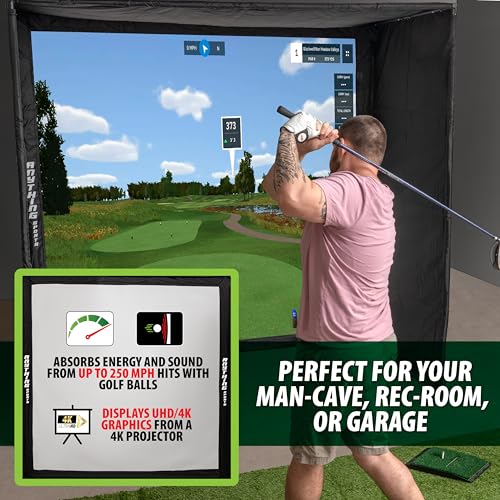
The Golf Simulator Cage by ANYTHING SPORTS offers a complete enclosure system designed to fit your indoor or outdoor golf setup. Available in three sizes, it includes all poles, impact netting, shank nets, and connectors, providing full protection during practice sessions. Easy to assemble in under an hour, this durable metal frame cage lets you bring your own projector and launch monitor for a customized golf simulation experience. Backed by a 12-month warranty and responsive customer support, it’s a reliable choice for safe and effective golf practice.
Includes sturdy cage frame, impact netting, and connectors. Complete setup for safe indoor golf practice with easy assembly and multiple size options.
- Complete Package: Includes all poles, nets, and connectors for full enclosure.
- Size Options: Available in three sizes to fit various spaces.
- Easy Setup: Assembles quickly, no special tools or skills needed.
- No Electronics Included: Requires separate purchase of projector and launch monitor.
- Space Requirement: Larger sizes need ample room for installation.
- Warranty Coverage: Limited to 12 months, which may be short for some users.
From Frustration to Fascination: My Garage Golf Journey
Standing in that empty garage three years ago, I couldn’t have imagined the transformation that was about to unfold. The space that once housed lawn mowers and holiday decorations was about to become my personal Augusta National, my private Pebble Beach, my sanctuary where every swing mattered and every shot taught me something new.
The decision to install a garage golf simulator wasn’t just about convenience – it was about reclaiming my love for a game that had started to feel more like punishment than pleasure. After years of weekend rounds that left me more frustrated than fulfilled, I needed a space where I could practice with purpose, where every session brought measurable improvement.
The Initial Challenges: More Than Just Space
Converting a garage into a functional golf simulator space presented challenges I hadn’t anticipated. The concrete floors were unforgiving, the ceiling height barely adequate, and the lighting situation was, frankly, terrible. But each obstacle became an opportunity to create something better than I’d originally envisioned.
The first major hurdle was understanding the spatial requirements. A proper garage golf simulator setup needs more than just room to swing – it requires careful consideration of ball flight distance, ceiling height, and side clearance. My 20×20 garage seemed spacious until I started mapping out the swing area, projection space, and safety zones.
Temperature control became another unexpected challenge. Garages aren’t designed for year-round comfort, and maintaining consistent conditions for both equipment and comfort required thoughtful climate management. The concrete floors that seemed perfect for durability created issues with ball bounce and foot comfort during extended practice sessions.
Three Game-Changing Discoveries
Discovery One: Data-Driven Improvement
The moment I hit my first shot into the simulator and saw the immediate feedback – club head speed, ball velocity, launch angle, spin rate – I realized this wasn’t just practice, it was education. Every swing generated data that told a story about my technique, revealing patterns I’d never noticed on the course.
The launch monitor didn’t lie or flatter. When my swing path was too steep, the numbers showed it. When my clubface was open at impact, the ball flight displayed the result instantly. This immediate feedback loop accelerated my learning in ways that traditional range practice never could.
What struck me most was how the data revealed inconsistencies in my swing that felt identical. Shots that seemed similar produced wildly different results, and the simulator helped me understand why. This wasn’t just about hitting balls – it was about building a repeatable, reliable golf swing through understanding cause and effect.
Discovery Two: Mental Game Revolution
Playing virtual rounds on famous courses changed how I approached course management. When you can play Torrey Pines in January or tackle the Old Course at St. Andrews on a Tuesday evening, your perspective on golf strategy expands dramatically.
The simulator forced me to think beyond just swinging hard. Each virtual round presented strategic decisions – club selection, shot shape, risk management – that directly translated to better course play. I found myself studying hole layouts, considering wind conditions, and planning shots with an analytical approach I’d never developed on actual courses.
The pressure of virtual competition was surprisingly real. Playing against friends or online opponents in simulated tournaments created a competitive environment that sharpened my focus and revealed weaknesses in my mental game that had been masked by casual weekend rounds.
Discovery Three: Community and Connection
What started as solitary practice evolved into a social hub. Friends who’d never shown interest in golf became regular visitors, drawn by the novelty of indoor golf and the welcoming environment of the garage setup. The simulator became a bridge between serious practice and social entertainment.
Family members who’d been excluded from my golf obsession suddenly found ways to participate. The adjustable difficulty settings and game modes created opportunities for everyone to enjoy the experience, regardless of skill level. My garage became a place where golf brought people together rather than separating enthusiasts from non-players.
The online community aspect opened connections with golfers worldwide. Virtual tournaments, swing analysis discussions, and equipment reviews created relationships that extended beyond the garage. The simulator wasn’t just changing my individual game – it was connecting me to a global community of golf enthusiasts.
Overcoming Common Garage Golf Simulator Challenges
Space Optimization Struggles
The biggest challenge most garage golfers face is maximizing limited space while maintaining functionality. Standard garage dimensions rarely align perfectly with ideal simulator requirements, forcing creative solutions and compromises.
My initial setup was cramped and awkward. The hitting area felt constrained, and I constantly worried about damaging walls or ceiling fixtures. The key breakthrough came from understanding that optimal space usage isn’t about maximizing every dimension – it’s about creating one perfect hitting environment within the available area.
Strategic placement of the hitting mat, careful projection angle calculation, and thoughtful storage solutions transformed the cramped feeling into an efficient, purpose-built practice facility. The garage didn’t get bigger, but it felt infinitely more spacious once every element had its proper place.
Equipment Selection Confusion
The overwhelming array of simulator options, launch monitors, and accessories creates analysis paralysis for many garage golfers. Budget constraints compound the confusion, making it difficult to distinguish between essential features and nice-to-have upgrades.
My equipment journey involved several false starts and expensive mistakes. The initial budget system seemed adequate until I experienced the limitations of basic tracking technology. Upgrading piecemeal proved more expensive than investing in quality components from the beginning.
The key insight was understanding that the launch monitor is the heart of any simulator system. Everything else – screens, projectors, software – supports the core function of accurate ball and club tracking. Prioritizing tracking accuracy over visual aesthetics proved to be the right approach for meaningful practice.
Technology Integration Headaches
Modern golf simulators involve complex integration of hardware and software components. Launch monitors must communicate with simulation software, projectors need proper calibration, and networking requirements can be surprisingly demanding.
Initial setup frustrations nearly derailed my enthusiasm. Software updates, calibration procedures, and connectivity issues created barriers to simply hitting golf balls. The technology that promised to simplify practice sometimes felt more complicated than actual golf.
Persistence and systematic troubleshooting eventually resolved most issues. Creating a startup checklist, maintaining software updates, and understanding basic troubleshooting procedures transformed the technology from an obstacle into a seamless part of the practice routine.
The Sensory Experience: More Than Visual Simulation
The first time you step into a well-designed garage golf simulator, the sensory experience is immediately different from traditional practice. The enclosed space creates an intimate environment where every sound – the whistle of the club through air, the impact of ball on clubface, the satisfying thud of a well-struck shot – becomes amplified and meaningful.
The visual immersion goes beyond just seeing famous golf courses on screen. Proper lighting, screen positioning, and projection quality create a sense of depth and distance that tricks your mind into believing you’re actually standing on the first tee at Pebble Beach or lining up a putt at Augusta National.
The tactile feedback from quality hitting mats and realistic ball response adds authenticity to the experience. Modern simulator mats provide appropriate give and feedback, allowing you to take proper divots and experience realistic impact sensations that translate directly to course play.
Building Your Golf Sanctuary: Practical Implementation
Essential Infrastructure Considerations
Converting your garage begins with honest assessment of structural requirements. Ceiling height is non-negotiable – most setups require minimum 9-foot clearance, with 10+ feet being ideal for full swing comfort. Electrical requirements extend beyond basic power needs, often requiring dedicated circuits for projectors and climate control.
Flooring preparation is crucial but often overlooked. Concrete provides durability but requires proper underlayment for comfort and equipment protection. Moisture control becomes essential for equipment longevity, particularly in climates with significant humidity variations.
Lighting design impacts both visual comfort and equipment performance. Natural lighting from garage doors creates glare issues, while insufficient artificial lighting strains eyes during extended sessions. Balanced, controlled lighting enhances both the visual experience and tracking accuracy.
Creating Optimal Practice Conditions
The garage environment requires thoughtful climate management for year-round usability. Temperature extremes affect both equipment performance and personal comfort, making heating and cooling considerations essential for serious practice routines.
Sound management becomes important for neighborhood relations and family harmony. Quality hitting mats and proper ball containment reduce noise transmission, while sound-absorbing materials can further minimize disruption during early morning or late evening practice sessions.
Storage solutions for clubs, balls, and accessories keep the space organized and functional. Mobile storage allows quick conversion between practice mode and regular garage use, maintaining family harmony while preserving your golf sanctuary.
The Ripple Effect: How Garage Golf Changed Everything
The impact of consistent, quality practice extended far beyond improved scores. The confidence gained from understanding your swing mechanics through data and repetition translated into course confidence that was immediately noticeable to playing partners.
Course management improved dramatically through virtual play experience. Having played hundreds of holes on challenging courses in simulation, real-world strategic decisions became more intuitive and aggressive when the situation warranted risk-taking.
The social aspect transformed relationships with both golf friends and family members. The garage became a gathering place where golf instruction happened naturally, where friendly competition flourished, and where the love of the game spread to previously uninterested family members.
Physical fitness benefits emerged from increased practice frequency. Regular swing practice, combined with the ability to play full rounds regardless of weather, maintained and improved golf-specific conditioning throughout the year.
Celebrating Progress: The Joy of Measurable Improvement
One of the most rewarding aspects of garage golf simulation is the ability to track and celebrate incremental progress. Unlike course play, where conditions and circumstances vary dramatically, simulator practice provides consistent baselines for measuring improvement.
Handicap improvements became steady and predictable rather than sporadic and mysterious. The combination of increased practice frequency and quality feedback created a positive feedback loop where improvement motivated more practice, which accelerated further improvement.
Personal milestones took on new meaning when supported by data. Breaking 80 for the first time wasn’t just a scorecard achievement – it was the culmination of measurable improvements in swing speed, accuracy, and course management that had been tracked over months of dedicated practice.
The garage simulator created space for honest self-assessment without the pressure and distraction of playing partners or course conditions. This honest evaluation, supported by objective data, accelerated improvement in ways that traditional practice never achieved.
Beyond the Garage: Lifestyle Transformation
The garage golf simulator became more than practice space – it evolved into a lifestyle change that affected how I approached challenges, planning, and goal-setting in all areas of life. The discipline of regular practice, the patience required for gradual improvement, and the problem-solving skills developed through equipment management translated into broader life applications.
Weather independence transformed my relationship with seasons and scheduling. Golf was no longer a fair-weather activity constrained by daylight hours and course availability. This consistency allowed for more regular practice routines and more predictable improvement patterns.
The social dynamics around golf changed completely. Instead of being limited to playing partners with similar schedules and skill levels, the garage simulator welcomed anyone interested in trying golf or improving their game. This inclusivity strengthened relationships and created new connections within the community.
Your Journey Starts Here: Inspiration for Action
Standing in your empty garage today, you might feel the same uncertainty I experienced three years ago. The space seems too small, the investment too large, the technology too complex. But every expert was once a beginner, and every impressive setup started with someone taking the first step despite uncertainty.
The journey from empty garage to golf sanctuary isn’t just about creating practice space – it’s about committing to improvement, embracing technology, and creating opportunities for joy and connection around the game you love. The garage golf simulator isn’t just equipment; it’s a statement of intention about your golf future.
Your individual journey will be different from mine, but the potential for transformation remains the same. Whether you’re a weekend warrior seeking consistency, a competitive player chasing improvement, or a golf enthusiast wanting to share the game with family, the garage golf simulator creates possibilities that didn’t exist before.
The empty garage isn’t a limitation – it’s a canvas waiting for your vision. The concrete floors aren’t obstacles – they’re the foundation for your golf dreams. The investment isn’t just financial – it’s an investment in countless hours of improvement, enjoyment, and connection with the game that brings us all together.
Take the first step. Measure your space. Research your options. Connect with other garage golfers online. The community is waiting to welcome you, and your golf game is waiting to be transformed. The journey begins with imagination, but it becomes reality with action.
Your garage golf simulator story starts now. What will yours become?
Frequently Asked Questions
Q: What is the minimum garage size needed for a golf simulator?
A: Most garage golf simulators require a minimum space of 10 feet wide, 15 feet long, and 9 feet high. However, 12×18 feet with 10+ foot ceilings provides more comfortable practice conditions and better safety margins.
Q: How much does it cost to set up a garage golf simulator?
A: Basic setups start around $3,000-$5,000 for entry-level systems, while premium installations can range from $15,000-$50,000+. Most homeowners find good value in the $8,000-$15,000 range for quality equipment that provides accurate feedback and durability.
Q: Do I need special electrical work for a garage golf simulator?
A: Most systems require standard 110V outlets, but you may need additional circuits for projectors, computers, and climate control. Some high-end projectors require 220V power. It’s recommended to consult an electrician for optimal setup.
Q: Can garage golf simulators work in cold climates?
A: Yes, but temperature control is important for equipment performance and personal comfort. Most launch monitors operate within specific temperature ranges, and extreme cold can affect screen materials and electronics. Heating solutions are often necessary for year-round use.
Q: How accurate are garage golf simulators compared to outdoor ranges?
A: High-quality launch monitors provide extremely accurate data for ball speed, launch angle, and spin rate. While environmental factors like wind aren’t replicated, the swing and impact data is often more precise than what’s available at most driving ranges, making them excellent for technical improvement.